
Quick answer: Flat roof maintenance means inspecting your roof at least twice a year — every spring and autumn — clearing debris, checking drainage outlets are unobstructed, and fixing minor membrane defects before they become leaks. A well-maintained flat roof in the UK typically lasts 20 to 25 years for felt or GRP systems, longer for single-ply or hot-melt systems such as those from Bauder UK, against as little as 10 years if maintenance is neglected.
A flat roof fails for one of two reasons: the materials were wrong for the job, or nobody looked at it for three years. The second reason is responsible for the overwhelming majority of flat roof replacements in the UK, and it is entirely preventable.
This guide gives you the exact roof maintenance routine a working roofing surveyor would follow on a domestic or light commercial flat roof — what to check, how often, and which early warning signs separate a £200 repair from a £6,000 replacement.
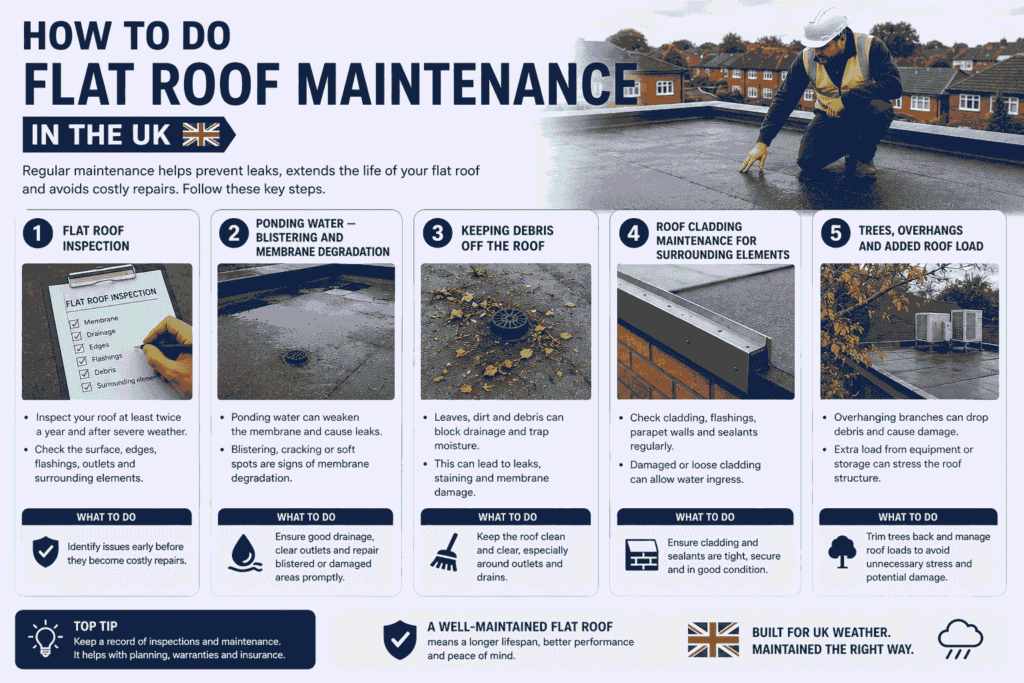
What Flat Roof Maintenance Actually Involves
Flat roof maintenance is the combination of scheduled inspection, debris clearance, drainage checks and minor repair carried out before deterioration reaches the waterproofing layer. It is not the same as roof cladding maintenance for pitched or vertical cladding systems, though the two are often confused — cladding maintenance focuses on fixings, joints and weather seals on a vertical or sloped surface, while flat roof maintenance focuses on a horizontal membrane that must shed water without any pitch to help it.
The four pillars of any proper flat roof maintenance programme are:
Debris removal — leaves, moss and grit block outlets and trap moisture against the membrane surface.
Drainage verification — outlets, gullies and downpipes must run freely; this single check prevents most ponding-related failures.
Membrane inspection — visual and physical checks for splits, blisters, lifted laps and UV degradation.
Prompt minor repair — a 10mm split repaired this week costs a fraction of the water damage it causes in six months.
Get these four right and a domestic flat roof in the UK will comfortably outlast its expected lifespan. Skip them and even a premium membrane will fail early.
Flat Roof Inspection — How Often and What to Check
The industry standard, recommended by manufacturers and the NFRC alike, is a flat roof inspection twice a year — once in spring once the worst of winter weather has passed, and once in autumn before leaf fall and freezing temperatures set in. Properties near overhanging trees, in coastal locations, or carrying rooftop plant equipment should inspect quarterly.
A proper flat roof inspection covers six specific checks:
- Surface condition — walk the full roof area looking for blistering, splits, cracking, or areas where the membrane feels unusually soft underfoot
- Lap joints and seams — the majority of leaks originate at joints between membrane sheets or sections, not in the open field of the roof
- Upstands and flashings — check the junction where the membrane turns up against parapets, rooflights and pipe penetrations; these movement-prone areas fail before flat sections do
- Drainage outlets — confirm gullies, gutters and downpipes are clear and water exits freely when tested
- Standing water — note any areas holding water more than 48 hours after rainfall has stopped
- Internal ceiling checks — staining or discolouration on ceilings below the roof is often the first visible sign of a developing leak, sometimes weeks before it is visible from above
Document each inspection with dated photographs. A photographic record lets you compare condition year on year and gives any roofing contractor exact context if repair work is needed.
Ponding Water — Why It Is the Single Biggest Threat
Ponding occurs when water remains on the roof surface for more than 24 to 48 hours after rain has stopped, almost always caused by insufficient fall, a sagging deck, or a blocked outlet. It is the most damaging condition a flat roof can experience because the consequences compound on each other.
Standing water accelerates UV and thermal degradation of the membrane in the affected zone, encourages algae and moss growth that physically lifts and weakens the surface, adds substantial dead load to the roof structure, and in winter converts to ice that expands within any existing micro-crack — turning a hairline defect into a split overnight.
If you find ponding during a flat roof inspection, check the nearest outlet first. Roughly 80% of ponding cases trace back to a partially or fully blocked drainage point rather than a structural fall problem. Clear the outlet and monitor; if ponding persists after a dry week with the outlet confirmed clear, the roof fall itself needs assessment by a roofing professional.
Blistering and Membrane Degradation
Blistering appears as raised bubbles in the membrane surface, caused by moisture or air trapped between layers expanding under heat. It is most common on multi-layer systems such as built-up felt roofing and is accelerated by poor lap welding during installation, ageing of the membrane, and repeated freeze-thaw cycling through a UK winter.
A small number of stable blisters rarely threaten roof performance on their own. The concern is progression — blisters that grow, multiply, or appear alongside cracking indicate the waterproofing layer is failing structurally, not cosmetically. Any blister that has split open should be treated as an active leak point and repaired without delay, since it provides a direct route for water into the roof build-up.
Keeping Debris Off the Roof
Leaves, moss, grit and wind-blown litter accumulate fastest around outlets, parapet edges and any rooftop plant. Left unchecked, organic debris breaks down into a fine silt that blocks gullies, holds moisture against the membrane and provides a growing medium for moss and weed roots that can physically penetrate ageing felt and bitumen surfaces.
Clear debris using a soft-bristle broom or low-pressure blower — never a metal-tined rake or stiff wire brush, both of which can score or puncture single-ply and GRP membranes. Clearance should happen at every scheduled inspection and additionally after any storm event or heavy autumn leaf fall.
Roof Cladding Maintenance for Surrounding Elements
Where a flat roof meets vertical cladding, parapet walls or roof-mounted plant housings, roof cladding maintenance becomes part of the same routine. Cladding fixings loosen over time through thermal movement, sealant joints around penetrations harden and crack with UV exposure, and capping details on parapets can lift in high wind if fixings have corroded.
Check cladding fixings for movement, inspect sealant joints for cracking or separation, and confirm any flashing that interfaces with the flat roof membrane remains correctly lapped and sealed. A failure at a cladding junction frequently presents as a roof leak even though the membrane itself is intact — which is why both systems should be inspected together, not separately.
Trees, Overhangs and Added Roof Load
Overhanging branches scrape membrane surfaces in wind, drop leaves that accelerate the debris problems above, and deposit sap that degrades certain membrane types on contact over time. Prune back any branch within reach of the roof surface as a standing maintenance task, not an emergency one.
Equally, audit anything added to the roof after original installation — satellite dishes, additional plant equipment, solar mounts — for excess point load and for penetrations that may not have been correctly sealed at installation. Snow accumulation in a cold UK winter should also be monitored on flat roofs with marginal structural capacity; excessive build-up should be professionally removed rather than walked on and shovelled by untrained hands.
How Long Should Flat Roof Maintenance Take to Pay Off
A flat roof maintained on the schedule above will typically reach or exceed its expected design life: 15 to 20 years for standard felt systems, 20 to 25 years for GRP fibreglass, and 25 to 30+ years for high-specification single-ply or hot-melt systems from manufacturers including Bauder UK. Neglected equivalents frequently fail 5 to 10 years early, with the bulk of that lost life attributable to undetected ponding and untreated lap failures — both caught easily by the twice-yearly inspection routine above.
Frequently Asked Questions
How often should flat roof maintenance be carried out?
Twice a year as standard — spring and autumn — with additional inspections after major storms or for roofs near overhanging trees or in coastal exposure.
What is the biggest cause of flat roof failure in the UK?
Undetected ponding water and blocked drainage outlets, responsible for the majority of premature membrane failures inspected by UK roofing surveyors.
Can I inspect my own flat roof, or do I need a professional?
Visual ground-level and binocular checks, debris clearance and drainage testing are safe for a competent homeowner. Any work requiring roof access should follow proper working-at-height precautions or be carried out by a trained roofing contractor.
Does flat roof maintenance prevent the need for full replacement?
In most cases yes. Consistent inspection and prompt minor repair is what allows a flat roof to reach its full design lifespan rather than failing prematurely from a problem that started small.
Use our free Flat Roof Cost Calculator to get an instant estimate if your inspection identifies a repair or replacement need.