
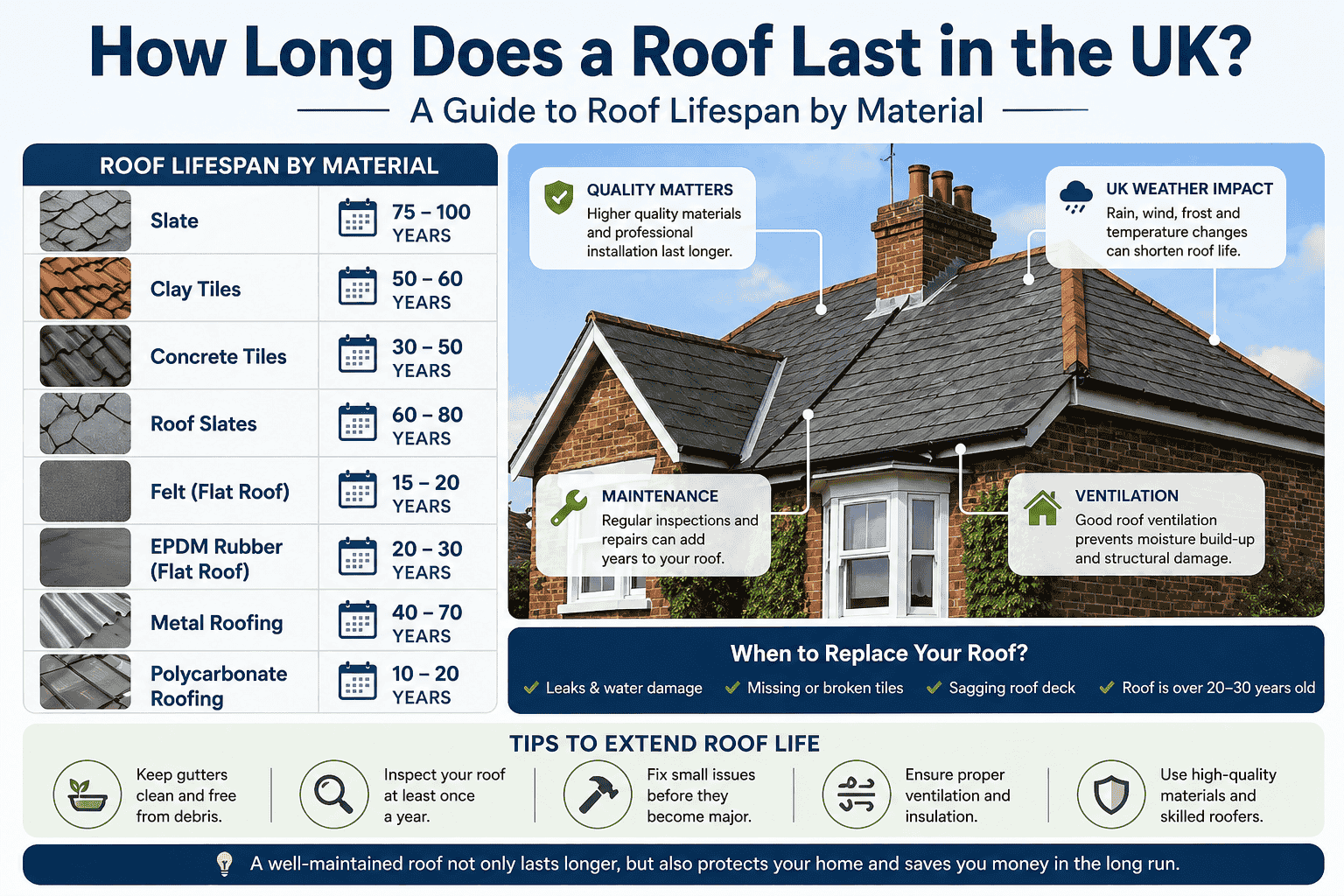
Quick answer: A UK roof lasts anywhere from 15 years for basic felt flat roofing to over 150 years for premium Welsh slate. The national average for a pitched tiled roof is 40–60 years. The single biggest factor is not the material you choose — it is how well the roof is maintained once installed.
If you are standing in your loft looking at a damp patch and wondering whether your roof has years left or months, this guide gives you the honest answer. We have broken down the real lifespan of every common UK roofing material, the specific factors that shorten or extend that lifespan in Britain's climate, and the clear signs that tell you whether you need a repair or a full replacement.
How long does the roof last in the
UK — By Material
The single most important factor in answering "how long does a roof last" is what the roof is made of. Here are the real-world lifespans for every common UK roofing material in 2026.
Pitched Roof Materials
Natural slate is the longest-lasting roofing material available in the UK. Welsh slate roofs installed in the Victorian era are still performing perfectly today — well over 100 years later. A properly installed natural slate roof using quality Welsh or Spanish material with copper or stainless steel nails can realistically last 80–150+ years. The limiting factor is almost never the slate itself — it is the nails, the lead flashings, and the timber battens beneath, all of which need periodic attention over that timeframe.
How long does a slate roof last? With quality material and professional installation: 80–150 years. With lower-grade Chinese slate: 30–50 years. The difference in lifespan between premium and budget slate is dramatic and frequently underestimated.
Clay tiles are the traditional roofing material on Victorian and Edwardian terraces across the UK and for good reason. Quality clay tiles from a reputable manufacturer last 60–100 years. They are harder than concrete, more resistant to frost damage, and age beautifully rather than degrading visually. Clay tiles that are correctly maintained — pointed ridges, clear gutters, no moss — routinely outlive the buildings they are installed on.
How long should a tiled roof last in the UK? Clay tiles: 60–100 years. Concrete tiles: 40–60 years. The 20–40 year gap between them is significant when comparing quotes.
Concrete tiles are the most common roofing material on UK homes built between 1960 and 2000. They are cheaper than clay, heavier, and have a shorter but still respectable lifespan of 40–60 years. The majority of concrete tile roofs that need replacing today were installed in the 1970s and 1980s — exactly at the end of their design life. If your home was built between 1960 and 1985 and has its original roof, it is worth getting a professional assessment regardless of whether you can see obvious problems.
Metal roofing splits into two very different categories. Standard steel and aluminium roofing lasts 40–70 years. Premium metals — copper, zinc, and terne-coated stainless steel — are genuinely lifetime investments lasting 80–100+ years. Lead, used on flashings and heritage roofing, lasts 50–70 years when correctly specified and installed.
Asphalt shingles are common in North America but relatively uncommon on UK residential properties. Where they are used in the UK, standard asphalt shingles last 15–25 years and architectural shingles 25–30 years. Their shorter lifespan makes them a less popular choice for UK homeowners compared to clay or concrete tiles.
What Affects How Long a Roof Lasts in the UK?
Knowing the average lifespan of your roofing material is only part of the answer. These five factors explain why two identical roofs on the same street can age very differently.
Installation quality is the factor most homeowners discover too late. A natural slate roof installed with iron nails instead of copper will fail within 40–60 years as the nails corrode and slates begin to slide. An EPDM flat roof with poor drainage falls will fail prematurely regardless of the membrane quality. The material's potential lifespan is only achievable with correct installation by a specialist — not a general builder who occasionally does roofing.
UK climate and location has a direct and significant impact. Britain's combination of high rainfall, regular freeze-thaw cycles in winter, and biological growth conditions is genuinely challenging for roofing materials. Coastal properties face additional salt-laden wind exposure that accelerates corrosion on metal components. Properties with overhanging trees retain more moisture and grow more moss. Two identical roofs in different locations can have very different practical lifespans.
Maintenance — or the lack of it is the single biggest controllable factor in how long a roof lasts. A concrete tile roof that is never inspected, has blocked gutters, and develops significant moss growth may fail at 30 years. The same roof properly maintained can comfortably reach 60 years. Regular maintenance — twice-yearly gutter clearing, annual visual inspection, prompt tile replacement, and periodic moss treatment — is the most cost-effective roofing investment any homeowner can make.
Ventilation is the hidden lifespan killer that most homeowners never consider. Inadequate loft ventilation causes condensation to form on the underside of roof timbers, leading to rot that compromises the structural integrity of the roof from the inside. A roof can appear perfectly sound from the outside while suffering serious damage beneath. If your loft feels unusually damp or smells musty, get the ventilation assessed.
Moss and biological growth in the UK's cool, damp climate is more damaging than many homeowners realise. Surface moss is cosmetic. Moss that has penetrated beneath the tile surface retains moisture against the tile and substrate, accelerating freeze-thaw damage, blocking drainage channels, and speeding deterioration significantly. Remove moss professionally — pressure washing tiles causes more damage than it prevents.
Clear Signs Your Roof Is Reaching End of Life
These are the signs that tell you a roof is nearing or past its practical lifespan — not just in need of a minor repair.
Multiple slipped or sliding slates or tiles across different areas of the roof — not isolated to one location — is the most reliable indicator of nail rot or widespread batten deterioration. When slippage is happening in several places simultaneously, isolated repairs become a losing battle.
Persistent leaks that return after repair in the same location indicate a systemic waterproofing failure rather than a single damaged tile. If the same patch has been repaired twice or more without lasting success, the underlying cause is beyond what spot repairs can address.
Visible daylight from inside the loft is the clearest possible sign of urgent structural failure. Water has almost certainly already penetrated if you can see daylight through the roof boards.
Widespread moss or lichen that has penetrated beneath tile surfaces rather than growing on top of them.
Sagging or uneven roof line visible from outside — this points to structural timber failure, not just surface material deterioration, and requires immediate professional assessment.
Age exceeding the material's design life — a concrete tile roof over 60 years old, a felt flat roof over 20 years old, or a slate roof where the original iron nails are known to be in place.
Repair or Replace — The Practical Decision Framework
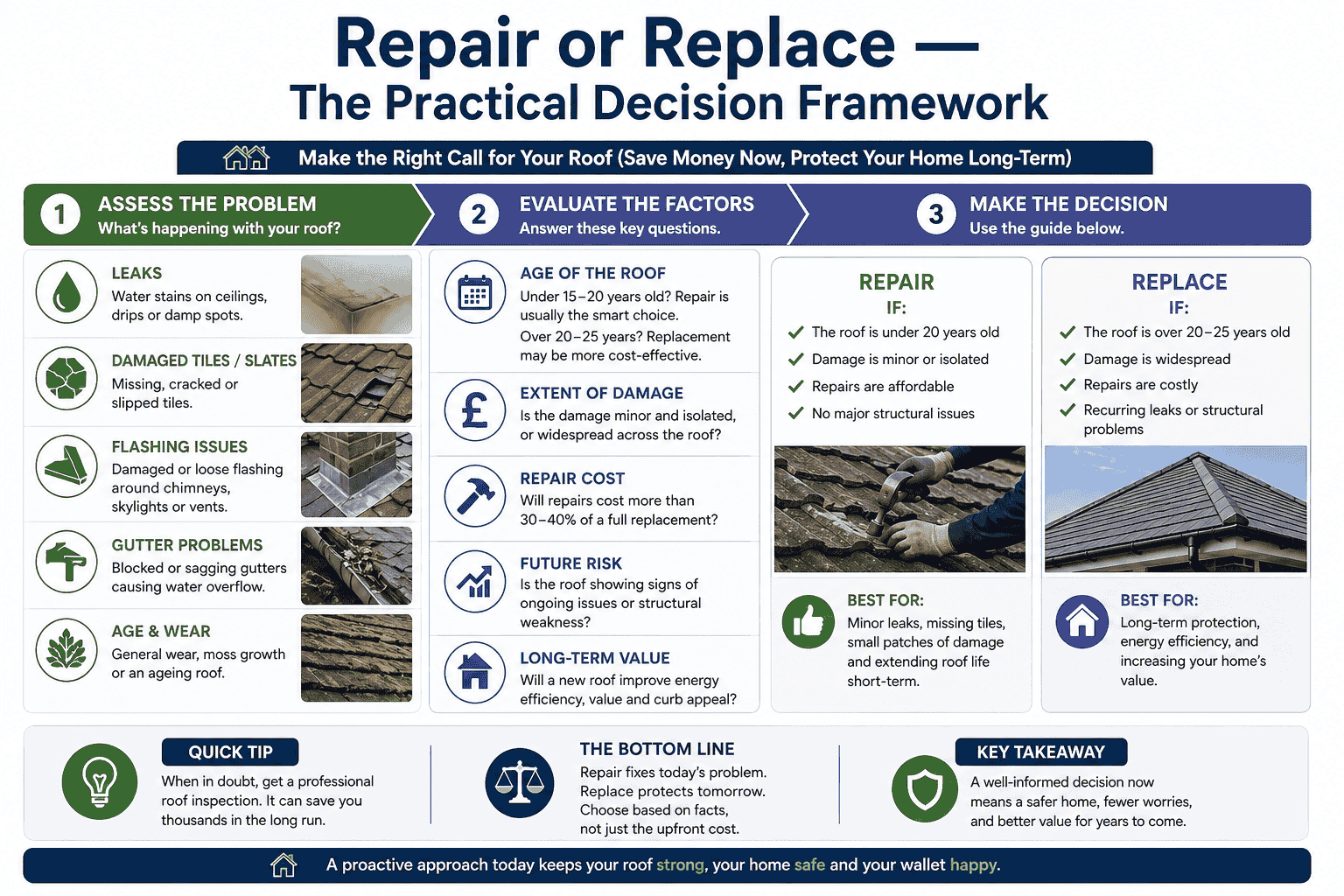
This is the question every homeowner reaches eventually, and the answer is not always obvious. Here is the framework professionals use.
Repair makes sense when the roof is less than halfway through its expected lifespan, damage is clearly localised to one area, the roof deck and structure beneath are sound, and the estimated repair cost is less than 35% of a full replacement quote.
Replace makes sense when the roof has reached or exceeded its expected lifespan, damage is widespread across multiple areas, the same sections have been repaired repeatedly without lasting success, or repair costs would exceed 40–50% of full replacement. A new roof also makes sense if you are planning to sell — a surveyor's flag on a near-end-of-life roof is one of the most common issues that slows or undermines a UK property sale.
The 40% rule is a useful shortcut. If the repairs you need would cost 40% or more of what a full replacement would cost, replace. You will spend the remaining 60% in further repairs within a few years anyway, plus the cost of any water damage to the structure in the meantime.
How to Make Your Roof Last Longer — 5 Practical Steps
Clear gutters every spring and autumn without fail. Blocked gutters cause overflow that saturates fascia boards, penetrates the roof edge, and accelerates rot. This single task prevents more roof damage than any other maintenance action.
Inspect your loft space twice a year — spring and autumn — looking for daylight, damp patches, or staining on the underside of roof boards. Five minutes in the loft twice a year catches problems when they are £200 repairs rather than £12,000 replacements.
Treat moss as soon as it appears rather than waiting until it is established. Professional moss treatment using appropriate biocides is far more effective and less damaging than pressure washing. Never pressure wash clay or concrete tiles — it strips the surface and dramatically shortens their remaining life.
Replace individual missing or broken tiles within weeks not months. A single missing tile exposes the underlay and timber beneath to water ingress. The tile costs £15 to replace. The resulting timber rot costs thousands.
Ensure adequate loft ventilation and check it has not been inadvertently blocked during loft insulation work — a very common issue on UK homes that had insulation installed as part of a government scheme. Blocked eaves vents are one of the most underdiagnosed causes of premature roof failure in the UK.
Frequently Asked Questions
How long does a roof last in the UK?
The average UK pitched roof lasts 40–60 years depending on material. Slate lasts 80–150+ years. Flat roofs last 15–50 years depending on material. The national average across all roof types is approximately 30–50 years.
How long does a slate roof last?
Natural Welsh or Spanish slate lasts 80–150+ years with proper installation and maintenance. Chinese slate lasts 30–50 years. Synthetic slate lasts 30–40 years.
How long should a flat roof last in the UK?
Traditional felt lasts 15–20 years. EPDM rubber lasts 40–50 years. GRP fibreglass lasts 30–40 years. Modified bitumen lasts 20–25 years. EPDM offers the best lifespan for most residential flat roofs.
How long should a tiled roof last in the UK?
Clay tiles last 60–100 years. Concrete tiles last 40–60 years. Both figures assume correct installation with adequate maintenance including clear gutters and prompt tile replacement.
How do I know if my roof needs replacing?
Key signs include multiple slipped tiles across different areas, persistent leaks after repairs, visible daylight from the loft, widespread surface cracking, sagging roof line, or age that has exceeded the material's design lifespan.